

WordPress continues to dominate the internet. According to the latest figures from W3techs, 40 per cent of all websites are still powered by WordPress. Its market share amongst content management systems stands at 58.1 per cent. Shopify comes in second place with just 7.8 per cent.
But the truth is also that WordPress’s dominance is crumbling. Following a steady rise over the last 11 years – from 23.3 per cent in 2015 to 43.6 per cent in 2025 – the proportion of WordPress websites is falling for the first time in a long while.
We’re also noticing this trend at Raidboxes. We’re hearing more and more often from our customers that they’re actively considering whether WordPress is still the right platform for them.
AI-generated websites, on the other hand, are on the rise. According to an analysis by digitalapplied, 35 per cent of all new websites are already created with the help of AI. Eight per cent of new websites are created entirely using AI-powered website builders. It is likely that these figures will rise even further in the future.
The advantages are obvious: AI websites can be created quickly, have very short loading times and can be built by absolutely anyone using a prompt. So that’s reason enough for us to ask: in the age of AI, does WordPress – which often seems so complex – still have a place at all?
Key takeaways
- Is WordPress dead? No. WordPress continues to dominate the web, accounting for around 40 per cent of all websites, but is losing ground to AI-powered site builders when it comes to simple new projects. The days when WordPress was the default choice for every single use case, without exception, are over.
- When AI-powered websites are the best choice: for short-lived landing pages, event pages, portfolios and MVPs. Static HTML code offers minimal loading times, zero maintenance and an extremely short time-to-market.
- When WordPress remains indispensable: for long-term B2B websites, editorial teams, online shops and complex interfaces (CRM/ERP). Its key strengths include 100% data sovereignty (open source), predictable total cost of ownership (TCO) and global development standards.
- The pros and cons are closely intertwined: AI is faster and cheaper for simple pages. However, as soon as complex logic is required, ‘vibe coding’ often leads to error-prone spaghetti code and security vulnerabilities. This is where WordPress saves time and money thanks to tried-and-tested plugins and community patches.
- AI also makes WordPress better: WordPress and AI are not mutually exclusive. AI now speeds up development and editorial processes (e.g. code snippets, translations, alt text) directly within the WordPress ecosystem.
- Our conclusion: WordPress isn’t dying – it’s becoming more professional. Whilst Prompt is often sufficient for simple business card websites these days, WordPress remains the platform of choice for scalable corporate websites.
The benefits of AI-sitebuilders
Anyone looking to create a simple website today will find a whole range of tools – from no-code generators such as Framer and Wix AI to vibe-coding environments such as v0, Bolt and Cursor – that significantly shorten the traditional development process.
This is where AI systems really come into their own:
Time to market
For initial digital launches, temporary event websites, MVP (Minimum Viable Product) test versions or dedicated marketing landing pages, the traditional WordPress set-up process is no longer competitive in terms of time.
Whilst with WordPress you first have to create databases, install themes, configure child themes and set up basic plugins, an AI prompt delivers a visually appealing, functional framework – complete with images and placeholder text – in just a few minutes.
Short loading times
The greatest technical advantage of many AI-generated websites lies in their architecture. They usually generate purely static code (HTML, CSS, JavaScript), which is delivered directly via global CDNs (Content Delivery Networks). This ensures a very low Time to First Byte (TTFB), as, unlike with WordPress, there is no need to execute PHP code or process database queries (MySQL) every time a page is loaded.
Zero Maintenance
Static HTML code is not affected by outdated PHP versions, Typo3/MySQL database conflicts or incompatibilities following a core update. It simply runs for years without any technical intervention.
Minimal attack surface
Where there is no admin dashboard, no login page (/wp-admin) and no database, traditional brute-force attacks or SQL injections come to nothing.
Custom code tailored to your needs
An AI-generated website is tailored entirely to you and your specific needs. No unnecessary features to bloat the website, and no dependencies on plugins, themes or WordPress core updates
No barrier to entry for non-techies
Managing a WordPress site requires a basic understanding of hosting, caching plugins, SSL certificates, updates and backup strategies. For sole traders or local service providers who simply want to display their contact details and opening hours online, all this technical complexity is simply a burden.
AI site builders simplify the user interface to natural language: enter text via a prompt, view a direct visual preview, and publish with a single click.
The benefits of WordPress
The speed of AI-powered website builders and modular systems is impressive. Technically, too, they are constantly improving and provide a solid code base. However, as soon as requirements become more complex, such systems reach their limits. This is where WordPress really comes into its own.
An overview of WordPress’s key strengths:
Features & Future-proofing
With WordPress, absolutely anything is possible. What starts out today as a simple landing page can easily be expanded in two years’ time to include a B2B customer portal, an ERP interface or a headless architecture with app integration.
This makes WordPress future-proof. It evolves in step with increasingly complex future requirements. The prospect of being forced to carry out a complete relaunch on a different system because the current tool ‘is no longer adequate’ is virtually out of the question.
Time savings when dealing with complex requirements
Many of the basic requirements for a modern website need to be outlined, tested and maintained using custom AI code via prompts. WordPress provides this basic infrastructure via its vast ecosystem at the click of a button.
- Features pre-configured by the manufacturer: Complex core requirements – ranging from automated image compression, redirect management and caching, through to GDPR-compliant cookie banners and structured sitemaps – are available for immediate use.
- Tried-and-tested specialist solutions: Whether it’s SEO optimisation (e.g. Rank Math / Yoast), accessible forms, WooCommerce for online shops or secure members’ areas – rather than reinventing the wheel using AI, WordPress utilises tried-and-tested modules that have been refined over the years and help to save time and money throughout the project.
Digital sovereignty
WordPress’s greatest strength is its independence. As a genuine open-source system, it guarantees businesses complete control over their most important digital asset.
- Full data sovereignty: the code, database, media and user data are 100 per cent owned by the website operator. There are no platform rules dictating which features are permitted or how content must be exported.
- Hosting flexibility: A WordPress instance can be easily backed up, tested locally and moved at any time to any server worldwide – whether to a specialist managed WordPress hosting provider, to your own cloud infrastructure or to a regional data centre.
- Established standards: As WordPress is based on globally recognised web standards, a project is not dependent on a single person or AI code. Any professional agency worldwide understands this tech stack and can seamlessly take over and continue existing set-ups.
The global ecosystem
No commercial AI builder and no isolated software company can replace the innovative power of a global open-source community.
- Swarm intelligence: Millions of developers, agencies and users test the system every day under real-world conditions. Thanks to this enormous coverage, bugs, performance bottlenecks and security vulnerabilities are often detected, reported and collectively fixed within hours.
- Documentation & Support: For almost every conceivable problem, there are already tried-and-tested solutions, forum posts, guides and specialist agencies. When faced with technical hurdles, you are never reliant on the overburdened ticket support system of a single SaaS provider.
User management
A professional corporate website is a dynamic tool for entire teams. WordPress has been developed over two decades with this collaborative approach in mind.
- Role and permissions system: WordPress offers detailed access permissions as standard (Admin, Editor, Author, Contributor). Marketing teams can create and publish content independently, whilst technical settings remain protected.
- Editor Experience (Gutenberg): The Gutenberg block editor offers editorial teams an intuitive, visual WYSIWYG interface. Staff can add content without affecting the global design system or the source code.
Predictable scalability
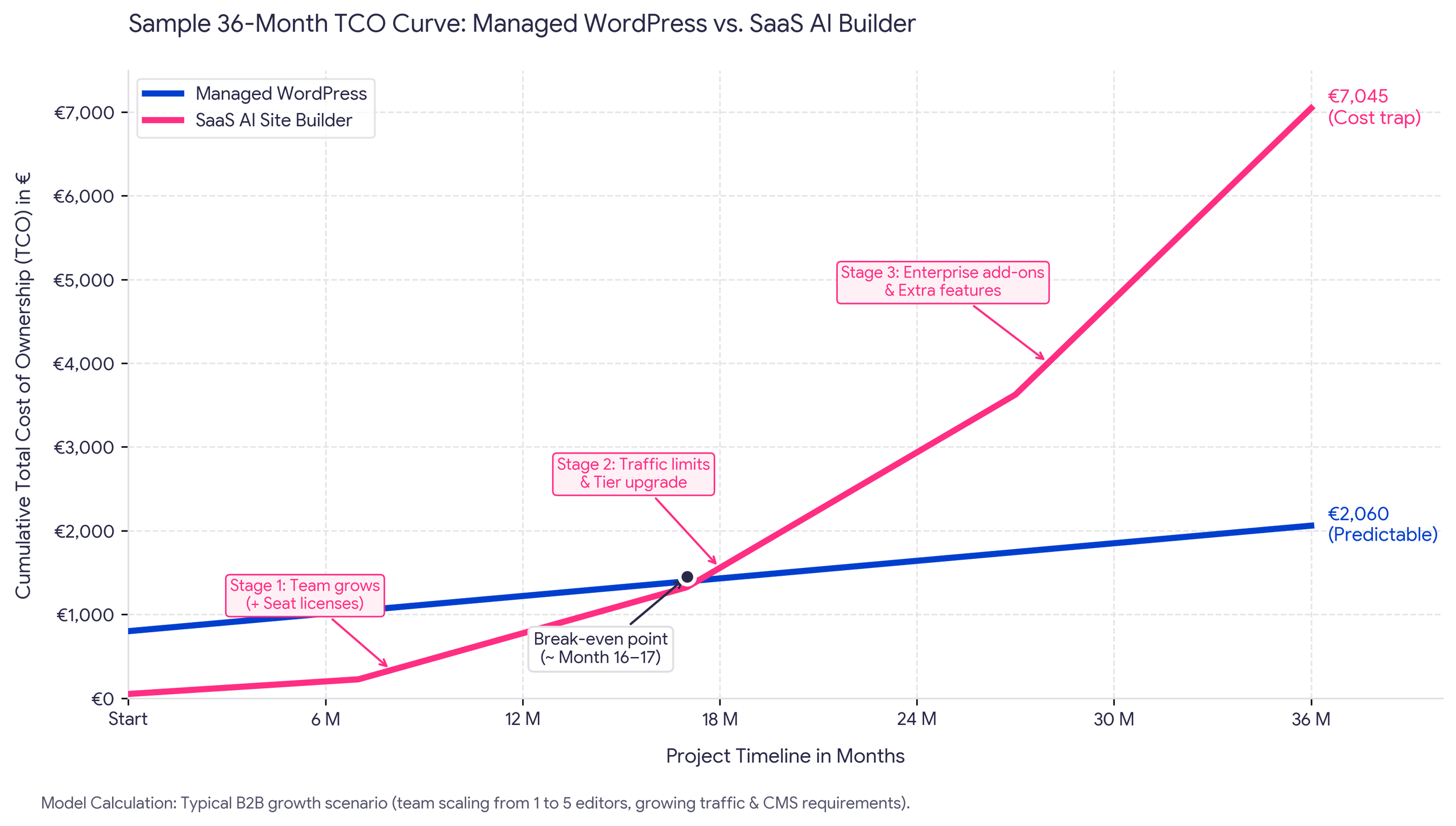
One of WordPress’s invaluable advantages lies in its transparent and predictable cost structure as businesses and teams grow.
- Team scaling: Whether two or two hundred editors are working on the website, it makes no difference to the WordPress licence costs. There are no artificial ‘per-seat’ surcharges for additional user accounts.
- Growth without feature restrictions: Whilst pure SaaS systems often restrict access to increased bandwidth, form submissions or language versions to expensive enterprise plans, WordPress scales purely on the basis of technical server power (CPU/RAM). This makes the total cost of ownership extremely predictable over the years.
When strengths become weaknesses
Anyone wishing to objectively compare an AI site builder with WordPress needs to keep the context firmly in mind: a feature that is considered an unbeatable advantage in one scenario may become a weakness in the next project.
The Speed and Cost Paradox
- The assumption: AI generators are always faster and cheaper than developing a WordPress site.
- The reality is that this is true for simple landing pages and static websites. However, as soon as specific logic is required – such as a customised workflow within a form or integration with an internal CRM system – the balance shifts.
- The turning point: if you try to teach an AI complex specialised functions using ‘vibe-coding’ (continuous prompting and trialling of source code), this often results in hours of debugging. What starts out as a quick experiment with AI turns into a cost trap. With WordPress, on the other hand, such requirements can usually be met by an established plugin that has been in development for years and can be configured in a matter of minutes.
The Security and Plugin Paradox
- The assumption: WordPress is vulnerable to hacks because of its plugins, whilst modern AI code is secure by design.
- The reality is that poorly maintained plugins or those from dubious sources are, in fact, the number one security risk for WordPress. At the same time, however, the ecosystem comprising security plugins, automatic patches and the global community is the strongest defence a CMS can offer.
- The turning point: a plain HTML page generated by an AI tool has almost no vulnerabilities due to the lack of a database. However, as soon as the AI generates backend scripts or database queries, the situation becomes critical. AI models tend to produce outdated code patterns or overlook security checks (such as sanitising user input to prevent SQL injections). Whilst in WordPress, vulnerabilities in the core or in well-known plugins are fixed centrally and rolled out, there is no provider for custom AI code that delivers security updates.
WordPress or AI for my website?
The choice of the right system should not be based on habit or blind enthusiasm for new technologies. The specific circumstances of the project are the decisive factor.
In practice, a simple rule of thumb can be applied:
The shorter the lifespan and the shallower the functional depth, the more it is worth looking into AI site builders. The more dynamic, long-lasting and team-oriented a project is, the more likely WordPress will remain the system of choice.
The following overview is intended to help you choose a system
| Criterion | AI Site Builder / Static Code | WordPress |
|---|---|---|
| Project type | Micro-site, event page, prototype, simple business card | Company website, magazine, online shop, customer portal |
| Service life | Short to medium term (< 12 months) | Spanning several years (> 2 years) |
| Editorial Team & Staff | 1 person (coder or owner) | Several people with different roles and permissions |
| Interfaces & Logic | No webhooks, or simple ones | CRM, ERP, e-commerce, custom post types, REST API |
| Maintenance costs | Virtually zero (for static HTML pages) | Regular updates (core, plugins, PHP) are required |
| Data sovereignty | Often tied to SaaS providers (vendor lock-in) | 100% ownership of the code, database and content |
How AI improves WordPress
The comparison between AI-powered website builders and WordPress does not have to boil down to a rigid ‘either/or’ choice. In practice, the two approaches are not mutually exclusive, but rather complement one another.
AI technologies are not replacing WordPress, but are changing the way it is used – both in development and in day-to-day editorial work.
AI in development
For developers and agencies, AI tools such as Cursor, GitHub Copilot and ChatGPT act as assistants that take care of time-consuming routine tasks.
- Code for custom requirements: Rather than manually writing boilerplate code for custom post types, Advanced Custom Fields (ACF) or Gutenberg blocks, the AI generates clean code templates in seconds. The developer’s role shifts towards architecture and quality control.
- Faster troubleshooting: In the event of unexpected PHP errors or conflicts between plugins, AI helps to analyse server logs and identify suitable solutions.
AI in the newsroom
For content managers, too, the integration of AI and WordPress has long been a reality. AI functions are fed directly into the Gutenberg editor via interfaces and specialised plugins.
- Accessibility & SEO: AI-powered plugins automatically generate suitable alt text for screen readers when images are uploaded, or suggest meta titles and descriptions.
- Multilingualism: Localisation no longer necessarily has to be carried out by external translation agencies. AI integrations translate existing page content directly within the database into other languages, after which editors simply add the finishing touches.
The hybrid agency workflow
Modern web development processes do not separate AI and CMS, but rather integrate them into a seamless workflow:
Is WordPress still necessary?
As we have shown, the question of whether WordPress is still relevant in the age of AI cannot be answered with a simple ‘yes’ or ‘no’. Rather, the answer is: ‘Yes, but its role is changing fundamentally.’
The days when WordPress was the undisputed go-to solution for absolutely every digital project – from a five-line portfolio to a corporate portal – are over. For lean, short-lived landing pages, simple business cards or prototypes, AI-powered site builders are now the quicker and lower-maintenance option. In this segment, WordPress is rightly losing market share to more efficient alternatives.
At the same time, the system is consolidating its position where it matters most: as a scalable, owner-managed foundation for complex corporate websites, e-commerce, multilingual portals and editorial teams. Where data sovereignty, custom interfaces, accessible standards and long-term maintainability are required, an established open-source CMS remains irreplaceable.
For agencies, freelancers and decision-makers, this means a change in mindset:
- The value is shifting: simply ‘putting together’ basic web pages is becoming less economically valuable, as AI takes over this task.
- Strategy will be crucial: in future, the true value of service providers will lie in system architecture, data compliance, the integration of complex processes and long-term support.
WordPress isn’t dying – it is moving beyond its role as a general-purpose tool and establishing itself as a professional platform for demanding B2B projects.
Frequently Asked Questions (FAQ) about WordPress and AI
Will AI make WordPress obsolete?
No. Whilst WordPress is losing market share to AI-powered site builders in the segment of simple, static websites, it is consolidating its position in the areas of complex corporate websites, editorial portals and e-commerce. Where custom interfaces, comprehensive rights management and 100 per cent data sovereignty are required, an open-source CMS remains indispensable.
When is an AI site builder a better option than WordPress?
AI site builders and no-code tools are ideal for short-lived landing pages, event pages, portfolio showcases or rapid MVPs (Minimum Viable Products). They offer an extremely short time-to-market, minimal set-up effort and low TTFB loading times thanks to static edge CDN delivery – all without any maintenance required for updates.
Are AI-generated websites more secure than WordPress?
Purely static HTML pages generated by AI builders offer virtually no vulnerability to typical attacks such as SQL injections, due to the absence of a database and a PHP backend. However, as soon as an AI generates bespoke backend code, the security landscape is turned on its head: unlike the WordPress ecosystem, there is no global community for bespoke AI code that centrally identifies security vulnerabilities and provides automated security patches.
Which is cheaper: WordPress or an AI site builder?
This depends heavily on the project’s lifespan and growth. In the start-up phase, AI site builders (SaaS) are often significantly cheaper, as there are virtually no set-up costs. However, as projects grow, the situation often reverses: SaaS platforms can quickly become a cost trap due to fees for additional user licences (‘per-seat pricing’), add-ons and traffic limits. Whilst a WordPress installation does require a larger initial budget (setup/hosting), the total cost of ownership scales completely independently of team size and remains predictable over the years.
How does the development of AI help WordPress agencies?
AI technologies do not replace dedicated WordPress agencies, but act as powerful assistants. During development, code copilots take over time-consuming routine tasks – such as writing boilerplate code for custom blocks or APIs – and significantly speed up debugging. During the design phase, AI helps to quickly build wireframes and content structures. This frees up time for agencies to focus on the real economic value: complex system architectures, data security, GDPR compliance and digital accessibility (WCAG/BFSG).


Leave a Reply